|
by Jim Paw-Paw Wilson Illustrated by Jock Dempsey and Walt Sherrill |
|
|
|---|
|
Since today is Sunday, we delayed breaking camp until after divine services this morning. The protestant minister held services for the Protestants, and I held the rosary service for the Catholic troops. Before I led the men in the opening prayers of the rosary, I read the list of our fallen, asking the men to pray for the repose their souls. I couldn't help but notice that several of the men had to wipe their eyes as I was reading the list. We got back on the road right after the noon meal, and marched till shortly before sundown. Then we camped for the night. We've been setting camp for so long that it only takes about an hour to have the entire encampment setup, including all of the tents. We are much quicker than we were just a few long years ago. There is one happy thing to write about, aside from the fact that we're going home.
Each day is much like the last. We march from about an hour after sunrise till about an hour before sunset. We are only on the road for a few minutes until the troops fall into that distance eating stride that has become so familiar. With very little effort, we cover from 25 to 30 miles a day. At night, after camp is set up and the troops have eaten, the troops gather around each fire to talk. I've been to several different fires, and the topic seems to almost always be about the same subjects. The men reminisce about the times they have shared together, both the good and the bad. The most commonly heard phrase is "Do you remember when...." Or someone will say, "You're not going to believe this, but so help me God, it's true!" Some story will follow, usually funny, sometimes poignant. Often, someone will mention one or more of the men that we have lost. When that happens, there is usually silence for a short time. This routine, if I may call it that, seems to be much the same in all of the groups. My men recall the funny incidents that have occurred when they were fixing some item or another. Our repair of the cannon called The Blacksmith has been mentioned a couple of times. It seems as if the men are recounting the events that they want to remember. Col. Callahan moves around the Regiment. Each night he spends time at a couple of the different fires. He talks to the men, not as an officer, not as their Colonel, but as a soldier talking to his friends. He too, frequently mentions the fallen and the sadness in his voice when he does is profound. Tonight Col. Callahan stopped by our fire. He talked with us for a while, then he said that he had a particular memory that he wanted to share with us. He reminded us of the Battle of Freeman's Farm. The command group was on the right of the line, and the British were coming closer. Suddenly, to his surprise he saw the artificer company marching toward the command group. We moved between them and the British, extending from a column of fours to line of battle. Without pausing until we were firmly in place, we began to fire as we came on line. The British were stopped in their tracks and soon retreated. After that, whenever the regiment was in battle, the Artificer Company always served as the guard for the command group. He said he didn't think he had ever said anything to us about it, and he wanted to thank us. I spoke up at that point and responded that we appreciated his gratitude, but we were only doing our duty. The men agreed with me, but Col. Callahan said that in other battles he had observed that the artificer companies from other units stayed back with their wagons. Although we had left a small guard under a corporal to guard our wagons, we had always taken part in whatever action was necessary, and he appreciated it. He mentioned that we had lost men, as had every company in the regiment, but that even with the reduced man power, we always managed to do our share of the regiments work. It made me proud of my men, and after the Col. left, I managed to tell them so. First Sgt. Baker replied that while they may have done the things that the Col had talked about I had always led the way. I was a bit embarrassed by his words, but just a bit proud, too. Then something happened that I didn't expect. Tom spoke up. He said that in all the time we have been together, not one time had anyone in the artificer company made any comment or treated him any differently than any other man in the company. He said that as the only freedman in the regiment, he had not expected to be treated as "one of the men". And he wanted us to know how much he appreciated that, and how much it meant to him. Then Cookie spoke up and said, "Tom, you have worked as hard, and fought as hard as any man in this regiment, and harder than some. You ARE one of us!" Tom's eyes filled with tears, and so did mine. They are all good men and good soldiers. Just one more day, and we'll be home! We stopped this afternoon about 10 miles from home. The Colonel talked to all of the officers yesterday and we in turn talked to the men last night. Everyone is cleaning and shining everything they can. The wagons are all being cleaned. Since this is the probably the last time we will march into town as a unit, we want to look as good as possible. Our uniforms are somewhat the worse for wear, but the men are sitting around their fires, sewing on buttons, sewing up small rips, trying their best to look as professional as they can. But in reality, these men don't have to TRY to look professional, they ARE professionals. It shows in everything they do. Camp is set at night in an hour or less. From the time they wake up until they are ready to be on the road isn't much longer than that, even allowing extra time for them to eat. On the road, they move in almost total silence. They stride along, and the miles seem to melt beneath their feet. What few commands we officers give are anticipated, and the men obey them almost before we can finish the command. Strangely enough, in spite of all the anticipation at seeing our loved ones, for me at least, there is some apprehension, too. It's been almost two years since the last time we were able to stop at home. We have changed a great deal in that period of time. And of course the people at home have changed also. While we've had pretty regular contact, thanks to the post riders, still letters are not the same as being there. I know, for example, that Willie isn't so little any more. He's a couple of months past his 5th birthday. And Dee Dee was 4 years old last month. I can't help but wonder if either of them will remember me at all. Willie might, but I doubt if Dee Dee will. I must remember to go slowly and not rush them, for I don't want them to be afraid of me. Dee has had to do things that she would not have had to do if I was home. I know that she has been working in our little shop almost every day, and that she has helped Master John a good bit at the shop. I would like for her to be able to stay at home with the children now, but she may not want to do that. Dee says that Willie is growing into a sturdy little fellow. Already he pumps the bellows for her when she works at home. He gets tired after a few hours, but she says he works longer than she thought he would. So MANY things have changed. I've changed too, and I'm not altogether pleased with some of the changes in me. I remember the first time I had to kill an enemy and how much it bothered me. The last few times, I haven't even thought about it. I've become hardened to it, and I'm not sure that is a good thing. I do know that I want to talk to Father O'Reilly about it. I'm almost as afraid to go home as I was to leave home. We are home. We got home Tuesday at just about noon. Colonel Callahan had the fifes and drums silenced for about the last mile before we got to town They started to play as soon as we entered the outskirts of town. I don't think we had marched a block before the church bells started to peal. People came running from all directions, and the cheers and screams of joy were deafening. But they didn't interrupt our line of march, they all gathered behind us and followed us to the town square. Col. Callahan had intended for us to go to the muster ground but when he saw the crowds, he sent a rider back to all of the company commanders telling us that we were going to the town square instead. We in turn passed the word to our men so everyone would know what we were doing. When he stopped us, I had the wagons move behind the regiment, stop and all of the men dis-mounted and formed on the Regimental left, leaving one man with each wagon as a horse holder. The hostlers took their officers horses as we dismounted and moved them back behind the troops. Tom took Baron for me. The Mayor stood on the steps of the Magistrates house, with the Magistrate and other leading citizens, including Fr. O'Reilly and the other ministers standing on the porch behind him. As soon as we were all in position, Col. Callahan signaled the fife and drum corps to silence, and the whole square became silent. The Mayor spoke for a few minutes, welcoming us home, and telling us how glad he and all of the town were to see us. Then he asked Col. Callahan if he would speak. The Col. didn't speak long, but he took the time to tell the town's folk a bit about us. He mentioned each company in turn, naming the company commander, and telling something that the company had done. He mentioned that our regiment had a reputation with the regular army of being one of the best disciplined of all of the militia regiments. And that we were known for taking any mission we were asked to take, and accomplishing it in a timely and professional way. He mentioned that the Artificer Company was considered by many of the regular army to be the equal or superior of any other Artificer Company in the Army. He even told how Rob had designed the duty rosters that made things work so smoothly when we were in camp. When he finished, he moved from the porch to the front of the formation and gave the command, "Company Commanders take charge of your companies and dismiss the men!" He returned our salutes and walked to where Lt. Col. Alsop was holding their horses. I saw him wipe his eyes as he got to his horse, and just lean against the saddle for a moment. I turned to my men, told them that they knew where the horses and wagons were supposed to go and would they please take them there when I dismissed them. Then I did something that I have often wanted to do. Rather than immediately dismissing them, I first drew my sword and saluted them. I saw the surprise on their faces, and then First Sgt. Baker's voice boomed from his place behind the formation, ordering them to "Carry, ARMS!" and they returned my salute. I returned my sword to it's scabbard and gave them "Dismissed!" They broke formation, and gathered around me to shake my hand and say fare thee well for now. Many of them told me that if I ever needed anything, all I had to do was let them know. My eyes were not the only ones that were full of tears. Then the riot started! Not really of course, but the town's people came into the square to claim their own. I had very carefully not looked directly at Master and Mistress, or Dee and the children, because I knew that when I did I would start to cry. As they got to me, Master and Mistress held back a bit, each holding one of the children, so Dee got to me first. Dee held me so tightly I could barely breath. We were both crying, and I could see that Master and Mistress were also. Finally, I took my left arm from around Dee, and reached for Master and Mistress. They came to me immediately and we were standing in a circle, all holding onto each other. All crying. Then Master John said a prayer of thanksgiving, and we all said an Our Father together. Little Willie remembered me! Not well, but enough to call me father! I knelt on the ground, right there in front of God and everybody, held my arms out to him and he came to me right away. And since he was holding Dee Dee by the hand, she came too. She looked a little frightened when I took them into my arms, but only for a second. I stood up, picking both of them up as I did so, and their arms went around my neck. 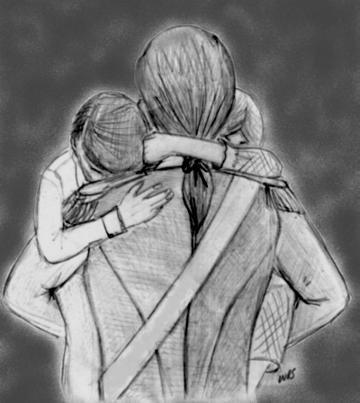 I will hold that moment in my heart for the rest of my life. There was a surprise waiting for Tom and me as we walked home. I was leading Baron, with Dee on my arm. Tom was beside me, with Faith on his arm. Rob was driving the wagon with Reb sitting beside him. When we got to Master John's blacksmith shop, I noticed a change.
Master John responded saying, "You are both most welcome. That's MY way of saying `Thank You!` to both of you for helping to make this a free country. Will, we will need to see about arranging Master's papers for Tom as soon as possible." When he said that I grinned, opened up the small valise behind my saddle, and took out the necessary papers and handed them to Master John. He read them, then with a big smile on his face handed them to Tom who had been standing there with a strange look on his face. Tom read them and started to cry for the second time that day. (He had also cried when Faith ran into his arms holding their son when the troops were released.) He couldn't say anything, just stood there with great tears running down his face. He handed the papers to Faith and reached for both of our hands. Father O'Reilly has spread the word that Sunday morning will be a High Mass of Thanksgiving and he has asked all of us from the regiment to please wear our uniforms to church. So I guess I will wear it one more time. Dee has been washing and mending, and getting it into almost perfect condition for me. Father has asked all of the company commanders, including the Protestants, to please attend the Mass and be prepared to call the roll of our fallen. I hope I can do that without breaking down Mass this morning was beautiful, as I had known it would be. When it came time for the homily, Father said, "Today's mass is a Mass of Thanksgiving for the safe return of our soldiers. But it is also a Mass of Remembrance for those who did not return." Then he called Colonel Callahan to the front of the church. Standing just in front of the altar rail, Colonel Callahan called the commanding officer of each company forward. The commanding officers stood next to Col. Callahan and read the roll call of the men who lie buried on so many of the battlefields from the late conflict. As each officer finished, he gave his list to Father to place on the altar, then stepped to his left or right to make room for the next commander. I too, in my turn, went forward to call the roll of my honored dead. I was not the only officer who had to stop a time or two to collect myself as I read. I was the last officer to read. After I finished, Col. Callahan spoke briefly saying that of the names that they had just heard, every man died facing the enemy, fighting for our freedom. We did not have a single desertion the entire time we had been gone. After he finished, he motioned for us to return to our seats, and followed us down the aisle. Then Father spoke. He didn't say much, and I'm not sure I can quote his exact words but it went something like this. "Six years ago I told you that my homily was walking down the aisle as I spoke. Today you have heard my homily read by these officers. Each of the names read here today will be transcribed into the parish records where they will be remembered for all time. I have asked the master mason to prepare a stone for our cemetery with all of these names on it. At the top of the stone it will say,1776 - 1781. The second line will read "IN LOVING MEMORY" followed by the list of names. After the names I have asked him to inscribe the words, "Greater love hath no man..." Then he continued with the Sacrifice of the Mass. At the Memento étiam, Dòmine (Be Mindful, O Lord) he moved the sheets with the lists of names on them to the center of the altar, offering the Mass for the fallen. 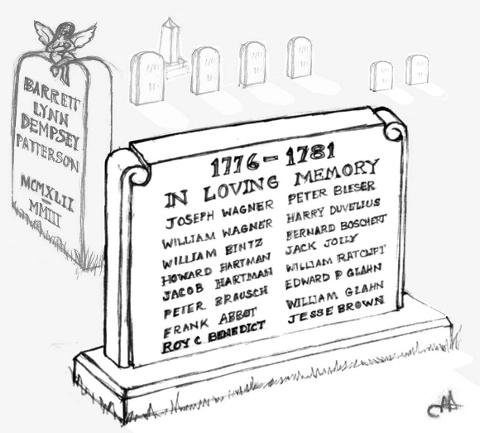 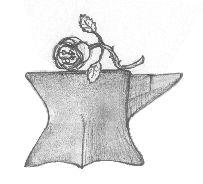 |
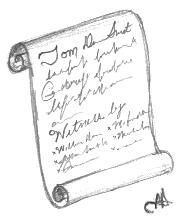 Naturally, I have my Journeyman/Master papers with me. I had Rob copy the formal
petition, putting Tom's name in the appropriate places and changing the date. Before we left
Yorktown, I visited several of the other artificer companies. At each of them, I talked to the
Master Smith. Four of them had seen enough of Tom's work that they were willing to write
letters of recommendation for him and to sign the petition to the magistrate. Tom doesn't know
this, but shortly after we get home, I'll ask Master John to sign it too, and then he and I will take
Tom to the magistrate's office and have his Master's papers signed. He's more than earned the
right to the title in the last four years.
Naturally, I have my Journeyman/Master papers with me. I had Rob copy the formal
petition, putting Tom's name in the appropriate places and changing the date. Before we left
Yorktown, I visited several of the other artificer companies. At each of them, I talked to the
Master Smith. Four of them had seen enough of Tom's work that they were willing to write
letters of recommendation for him and to sign the petition to the magistrate. Tom doesn't know
this, but shortly after we get home, I'll ask Master John to sign it too, and then he and I will take
Tom to the magistrate's office and have his Master's papers signed. He's more than earned the
right to the title in the last four years.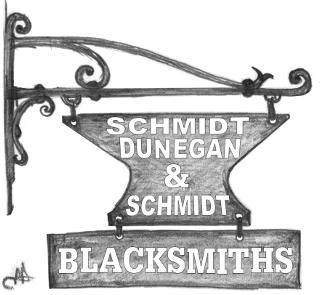 The sign on the front of the building had always had an anvil painted at the top, with the
words "JOHANN SCHMIDT" and "Blacksmith"under the anvil. But it was different now. Now
the sign read "SCHMIDT, DUNEGAN & SCHMIDT" with the word "Blacksmiths" below it. I
pointed it out to Tom. Neither of us could speak for a minute, then as one we turned to Master
John to say "Thank You!"
The sign on the front of the building had always had an anvil painted at the top, with the
words "JOHANN SCHMIDT" and "Blacksmith"under the anvil. But it was different now. Now
the sign read "SCHMIDT, DUNEGAN & SCHMIDT" with the word "Blacksmiths" below it. I
pointed it out to Tom. Neither of us could speak for a minute, then as one we turned to Master
John to say "Thank You!"